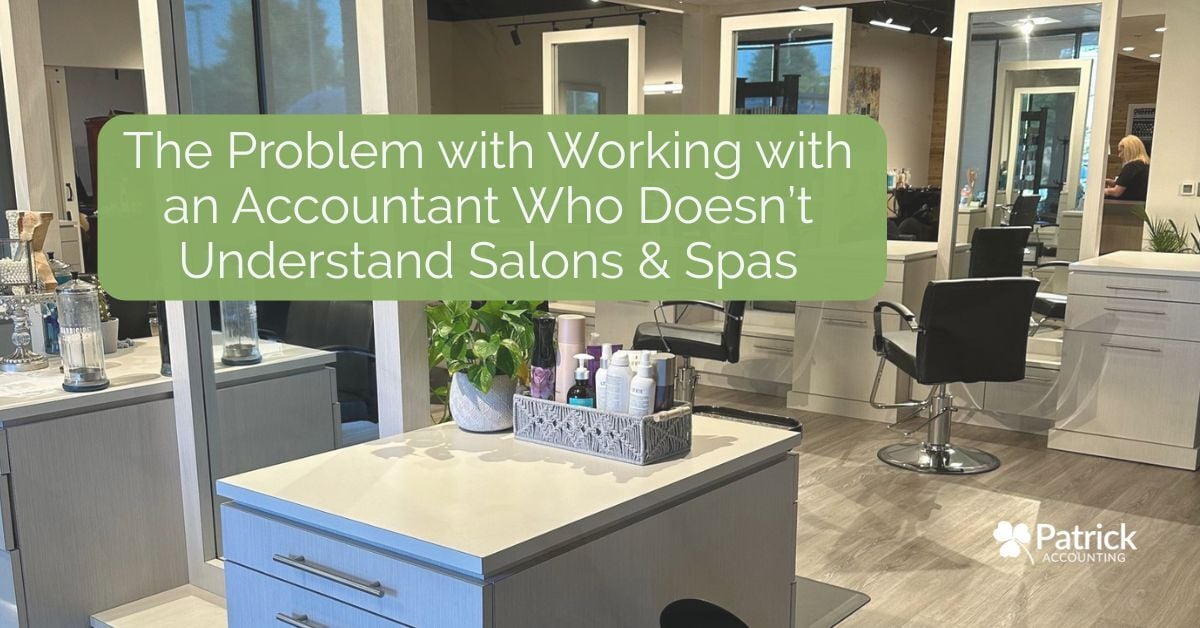
The Problem with Working with an Accountant Who Doesn't Understand Salons
July 28th, 2026 | 6 min. read
By Matt Patrick
The short version:
A salon isn't a generic small business. It's part retail, part labor-heavy service, with tipped employees and expensive equipment, and a generalist accountant tends to treat it like everything else. That's where the costly errors start: misclassifying stylists as contractors, missing the FICA tip credit, and getting entity structure or state filing wrong. This article covers what to watch for and the questions that tell you fast whether your accountant actually knows salons.
Does your accountant actually understand salons? Or do they treat yours like any other small business that happens to sell haircuts?
And if they didn't understand the difference, would you know before it cost you real money?
For a lot of salon and spa owners, the answer is no, at least not until something goes wrong. Your accountant files your return, the books look fine on the surface, and you assume everything's handled. Salons carry a specific set of accounting challenges that a generalist rarely sees, and when those get overlooked, the cost shows up as payroll penalties, unclaimed credits, and taxes you didn't need to pay.
We've worked with salon and spa owners, and we've seen what walks in the door when they leave a generalist. So, here's what accountants get wrong about salons, the questions that reveal whether yours knows the industry, and what tends to turn up once someone finally looks closely.
Why Salons Are Harder to Account for Than a Typical Small Business
A salon or spa is really two businesses stacked on top of each other. You've got a retail operation selling product, and a labor-intensive service operation with stylists, nail techs, and massage therapists, each with different economics. Add tipped wages, high employee turnover, expensive equipment whether you own or lease your space, and a tech stack of POS, scheduling, and online booking that all has to feed the books cleanly.
A generalist accountant who mostly handles straightforward small businesses tends to apply generic assumptions to all of that. Most of the time you never see the gap, until a misclassified worker or an unclaimed credit turns into a number on a penalty notice or a bigger-than-necessary tax bill.
Misclassifying Salon Employees as 1099 Contractors
This is the single biggest risk a salon owner can take on, and it's the mistake we see most. Generalists often don't understand the classification rules for salon staff, including how they apply to part-time workers like massage therapists. Whether someone is truly a contractor or actually an employee depends on things like how they're scheduled and who supplies the materials they use, which is exactly the line our team at Whirks walks through in this guide to salon employee versus booth-renter misclassification.
If you get this wrong, the consequences stack up. If a worker is classified as a 1099 contractor when they should be an employee, you're carrying major payroll compliance exposure, the kind that surfaces as back taxes, penalties, and interest. And there's a second cost most owners don't realize: You can't claim the tip credit on non-employees, so a misclassification closes the door on a credit you'd otherwise be owed, without ever showing up as an obvious problem.
Missing the FICA Tip Credit for Salons and Spas
As of 2025, salons and spas can claim the FICA tip credit for the first time, and a generalist accountant may not even know the door is open. Because they don't often work with tipped-employee businesses, they don't optimize for them.
Our sister company, Whirks, put together a plain-English rundown of how the FICA tip credit works for salons and spas that's worth a read. And as noted above, this is tied directly to classification: If your workers are misclassified as contractors, the credit is off the table entirely.
The credit gives you a dollar-for-dollar reduction of the employer Social Security and Medicare taxes you pay on your team's reported tips. There are salon-specific details that matter, including a different wage threshold than restaurants use and the fact that the credit only helps a profitable business. We walk through exactly how it works (and those caveats) in our FICA tip credit guide for salons and spas.
For this article, the point is simple: If your accountant has never brought it up, that's a sign they aren't thinking about your salon the way they should.
Getting Entity Structure and State Tax Compliance Wrong
The third area generalist accountants get wrong is structure and state compliance. That means not understanding how your entity structure affects your personal taxes, how pass-through taxation actually works for an owner, and how state filing rules differ depending on where your salon operates.
As you grow, this starts to matter more. The right structure can protect you and lower what you personally owe, which is a real concern when you have a physical location where someone could get hurt. The wrong one (or one no one’s revisited in years) can leave you overpaying and underprotected at the same time. If you operate in more than one state, or you're thinking about it, the filing rules alone are enough to get wrong if an accountant doesn't handle them regularly.
Questions to Ask Your Accountant to Test Whether They Know Salons
You don't need to become a tax expert to figure out whether your accountant is one for salons. A handful of direct questions will tell you fast. Ask these and listen for whether the answers are specific and confident or vague and hedged:
How does the FICA tip credit work for salons and spas? A salon specialist should be able to explain it plainly, including the fact that salons became eligible starting in 2025.
How do overtime rules work for tipped employees in a salon? Tipped-wage overtime is its own calculation, and a generalist accountant often fumbles it.
What are the tests for classifying someone as an employee versus a contractor? They should talk about scheduling and who supplies materials, not just job titles.
How should I be structured given the state (or states) I operate in? Look for an answer that connects structure to your personal taxes and your specific location.
How will you proactively help me understand what my financial statements are telling me? You want a sounding board, not just a preparer who surfaces once a year.
If I outsource my books to you, what happens when someone is out sick or on PTO? The advantage of a firm is a whole team behind you, so there's no single point of failure to train, develop, or cover for.
The Number One Red Flag That Signals Your Accountant Doesn't Know Salons
If you only test one thing, test this: Can your accountant clearly explain the FICA tip credit and employee classification for a salon? Right now, those two are the clearest tell. They're specific to how tipped, labor-heavy, part-retail businesses operate, and an accountant who knows salons can walk you through both without hesitating. If the answers are fuzzy, or you get a blank look, that's your signal they don't know the industry well enough to protect you.
What We Find When Salons Switch From a Generalist Accountant
When salon owners come to us from a generalist, the same issues tend to surface. We're not sharing these to pile on the previous accountant. Most of these owners had no reason to know anything was wrong. But the pattern is consistent:
The FICA tip credit had never even been addressed. Not claimed and not discussed.
Workers were classified as 1099 contractors who should have been employees, based on how they were scheduled and the materials they used.
Depreciation wasn't being managed across years, so the opportunity to plan equipment write-offs and smooth out the tax impact over time was slipping away.
Any one of these can cost a salon real money. Together, they're the difference between an accountant who processes your return and one who's actively looking out for your business.
How to Know If Your Salon Has an Accountant Problem
For a while, you may have trusted a generalist and had no way to know what was slipping past you, because nothing looked wrong on the surface. That's where most salon owners start, and it's nobody's fault for not knowing what they were never told.
Now, you know what to look for: the classification mistakes, the missed tip credit, the structure and state issues, and the questions that reveal whether your accountant actually understands salons. That alone puts you in a stronger position than most salon and spa owners.
Going forward, the goal is to find an accountant who treats your salon like the specific business it is, so you keep more of what you earn and stop carrying risk you didn't know you had. At Patrick Accounting, we work with salons and spas every day, and we spend our time simplifying exactly this kind of tax, payroll, and compliance complexity so owners can focus on running their businesses.
If any of this sounds familiar, the simplest next step is a second opinion. Let our team take a look at whether your salon's books have these exact problems. Schedule a conversation with us, and you'll walk away knowing where you stand, even if you never work with us.
Not ready to talk yet? Start by testing the piece that carries the most risk. Our 1099 vs. W-2 assessment can help you determine whether your workers are classified correctly.
Frequently Asked Questions About Salon Accounting
How do I know if my accountant understands the salon industry?
Ask them to explain the FICA tip credit for salons and the tests for classifying a worker as an employee versus a contractor. Those two topics are specific to how salons operate, and an accountant who knows the industry can walk through both clearly. Vague or hedged answers are the tell.
Can salons and spas claim the FICA tip credit?
Yes. As of 2025, salons and spas can claim it for the first time. It reduces the employer Social Security and Medicare taxes you pay on your team's reported tips, though there are salon-specific details, including a wage threshold that differs from that for restaurants and the fact that the credit only applies to profitable businesses.
What's the biggest accounting mistake salon owners make?
Misclassifying employees as 1099 contractors. It creates payroll compliance exposure, back taxes, and penalties, and it also disqualifies you from claiming the tip credit on those workers. It's usually a sign the accountant doesn't understand how salon staffing works.
