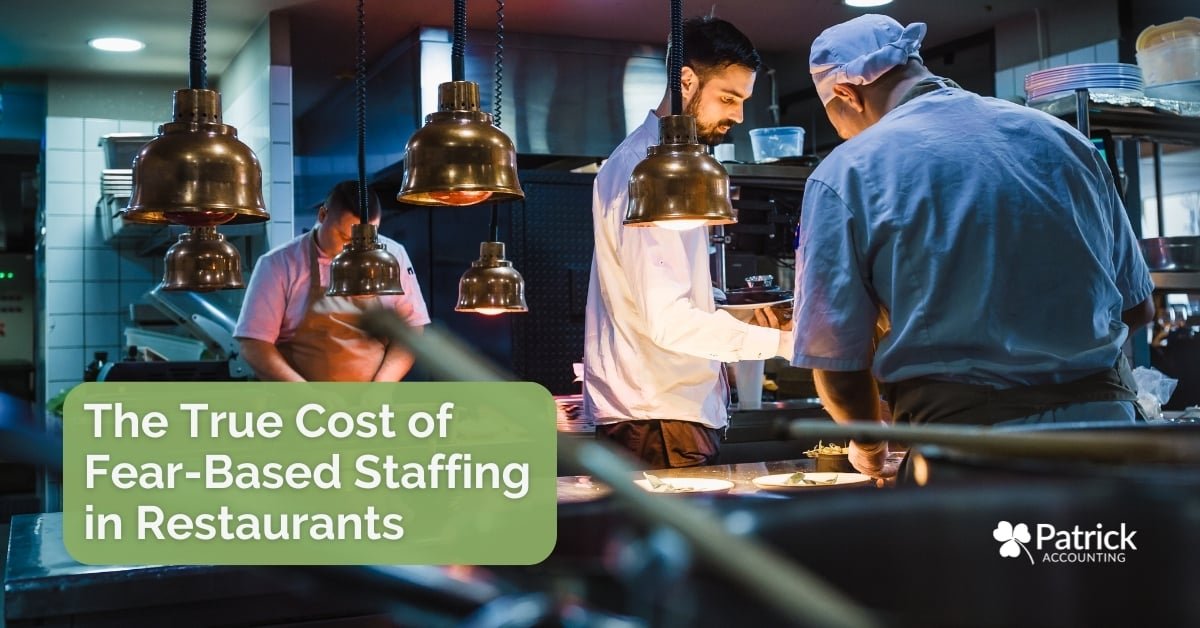
It’s 6 AM, and you’re staring at today’s schedule. You have 10 catering orders to get out the door, but you’re not confident about who’s actually going to show up.
So you do what most restaurant owners do. You overstaff. You schedule extra coverage, approve overtime, and hope it all works out.
Sound familiar?
At Patrick Accounting, we’ve worked with hundreds of restaurant operators across the Southeast. And one pattern shows up again and again: Fear-driven staffing decisions are often the most expensive ones you can make.
Why Restaurant Staffing Feels So Unpredictable
Every day can feel like a guessing game:
- Will your opener show up?
- Is your best server going to call in "sick" again?
- Will that new hire you just trained disappear without notice?
That uncertainty creates a pattern. When you can't predict who will show up, you overcompensate. And when you overcompensate, you overspend.
This daily anxiety creates a cycle of expensive decisions.
Most restaurant owners aren’t staffing based on what their business actually needs. They’re staffing based on what they’re afraid might happen.

The 4 Ways Fear Shows Up in Your Staffing Decisions
Fear doesn't show up in your staffing decisions randomly. It follows predictable patterns, and each one has a direct cost.
Fear #1: "What If No One Shows Up?"
This is the most common and most expensive one.
We had a client who runs a breakfast concept tell us, "I have 10 catering orders most mornings, but I don't always trust who's going to show up. So I overstaff it."
Here's what that looks like:
- You schedule two people for every key role "just in case"
- You approve overtime to make sure you're covered
- When everyone does show up, you end up paying for labor you didn't need
Now multiply that across a full year.
If you overstaff by just one person per shift, five days a week, that's about 260 extra shifts per year. At $15 per hour for a 6-hour shift, that's over $23,000 a year in unnecessary cost..
And that's just one role.
Overstaffing “just in case” quietly adds tens of thousands of dollars in unnecessary labor costs each year.
Fear #2: "I'm Desperate, So I'll Pay Whatever It Takes!"
When you’re short-staffed, urgency takes over. And that often means you hire quickly, pay more than planned, and skip your normal standards just to fill the gap.
Outside of paying higher wages, the real cost of desperate hiring usually results in poor fit, rushed training, and higher turnover. Those hires often create more problems than they solve, and you end up paying for it long after they’re gone.
Fear #3: "I Can't Fire Them. They've Been Here Forever."
This is the loyalty trap.
You have someone who’s been with you for years. They know the menu, and customers like them. But they’re unreliable, and your team has to constantly adjust around them.
What this costs you:
- You're paying for inconsistency
- You're overstaffing to compensate
- You're lowering the standard for the rest of your team
When you keep someone out of habit or guilt, it isn’t loyalty. It’s a business decision. And in a low-margin industry, those decisions add up quickly.
Fear #4: "If I Send People Home, They'll Quit."
This one shows up every single shift.
Sales are slower than expected. You're overstaffed. But you're afraid to send anyone home because you don't want to upset your team or risk losing a good employee.
So instead, you keep everyone on the clock. You pay everyone for a full shift when you only needed half the staff.
And you do it again the next day. And the next.
In a business with thin margins, you can't afford to carry labor your sales don't support. Making that call might feel uncomfortable, but avoiding it gets expensive.
What Fear-Based Staffing Is Really Costing You
Let's put this into perspective.
Say your restaurant does $2 million in annual revenue. A healthy labor cost might fall between 28% and 32%, or roughly $560,000 to $640,000 per year.
Now, layer in common fear-based decisions:
- Overstaffing by 10%: $56,000-$64,000
- Overpaying because of desperate hiring: $15,000-$20,000
- Keeping underperforming long-term employees: $10,000-$25,000
- Not cutting labor when volume drops: $20,000-$40,000
Fear-based staffing can cost a restaurant $100,000 or more per year.
That money should be profit. Instead, it's the cost of operating without confidence.
What "Ride or Die" Employees Actually Look Like
Restaurants with the strongest labor performance consistently build and maintain a reliable core team, rather than relying on low wages to control costs. These are your "ride-or-die" employees, and they're the people who show up, do the work, and don't leave you scrambling every shift.
These ride-or-die employees share three core traits:
- Reliability: They show up when scheduled and communicate when they can't.
- Competence: They can do their job without constant supervision.
- Accountability: They take ownership of their role and care about your business's success.
This kind of team doesn’t happen by accident. It comes from hiring intentionally, setting clear expectations, and holding people accountable when they fall short.
Why Fear-Based Staffing Comes Back to Revenue Predictability
At its core, fear-based staffing is a predictability problem.
When you don't know what your sales should look like tomorrow, next week, or next month, you can't staff with confidence. Every decision becomes reactive.
But when you understand your patterns, from your covers to your ticket averages to day-of-week trends, you can plan ahead. You can schedule based on data instead of guesswork.
And when you replace guesswork with clarity, fear starts to disappear.
Fear-Based Decisions Are Expensive, But Fixable
Fear-based staffing decisions usually come from uncertainty, not a lack of leadership. And uncertainty is expensive.
Every overstaffed shift, every rushed hire, and every avoided conversation about performance adds pressure to a business that already runs on tight margins.
The difference comes down to how you handle these moments. You either avoid them or lean into the data, set clear expectations, and make the tough calls that keep your business healthy.
At Patrick Accounting, we help restaurant owners understand exactly where their labor costs are going and where fear might be influencing decisions more than data.
If you're constantly stressed about staffing, unsure about your labor costs, or tired of feeling like you're guessing every week, it might be time to take a closer look at your numbers.
Because running a restaurant is hard enough. You shouldn't have to pay extra for uncertainty.
Want to Know Where Your Restaurant Is Leaking Profit?
If fear-based staffing decisions are putting pressure on your margins, start by getting a clearer picture of what’s really happening in your business.
→ Take our Restaurant Profit Leak Diagnostic to identify the areas that may be draining profit, from labor costs to food cost issues and other operational blind spots.
Want to focus on labor first? → Download What’s Your Labor REALLY Costing You? to uncover the hidden labor expenses that often get missed.
If you’d rather talk it through, we'd love to have a real conversation about what your numbers are actually telling you.
