How to Streamline Your Financial Closing Process for Accuracy, Compliance, and Better Decisions
How confident are you in your agency’s financial reports at the end of each month?
If an auditor reviewed your books tomorrow, would everything reconcile cleanly?
Navigating the financial side of a home care or hospice agency can be challenging. Between billing complexities, multiple payer sources, and strict regulatory requirements, there's a lot to keep track of.
That's why month-end close is so critical for this industry. It's the process that ensures financial accuracy, supports compliance, and gives you the information you need to make smart decisions about your agency's future.
At Patrick Accounting, we work with home care and hospice agencies across the country. We've seen what happens when month-end close is treated as an afterthought, and we've seen how much smoother things run when agencies have a clear, repeatable process in place.
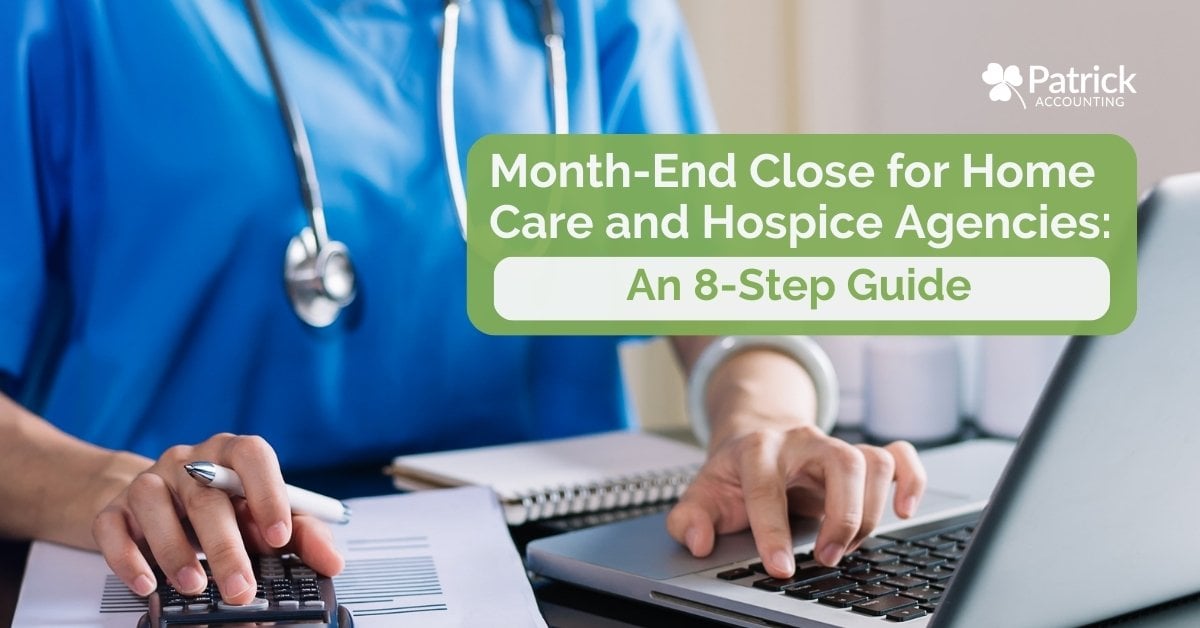
In this article, we'll walk through a step-by-step guide to streamline your month-end closing process, helping you achieve efficiency and accuracy in your financial operations.
Why Month-End Close Is Critical for Home Care and Hospice Agencies
Before we get into the steps, let's be clear about why this process is so important.
More than a bookkeeping task, month-end close is the foundation for everything else in your agency's financial life:
- Financial accuracy: You can't make good decisions with bad data. Month-end close ensures your numbers actually reflect what happened.
- Regulatory compliance: Medicare, Medicaid, and private insurers all have documentation requirements. A solid close process keeps you audit-ready.
- Informed decision-making: When you know where you stand financially, you can plan for growth, manage cash flow, and spot problems before they become crises.
A well-defined month-end close process saves time, reduces errors, and gives you the confidence that your financial reports actually mean something.
Month-end close turns raw financial data into reliable information you can actually use to lead your agency.

8 Steps to Complete Month-End Close for Home Care and Hospice Agencies
The exact process may vary depending on your agency's size and payer mix, but these eight steps form the foundation of a solid month-end close. Work through them consistently, and you'll have financial statements you can actually trust.
Step 1: Establish a Month-End Closing Schedule
The first step is simple but often overlooked: Set a clear timeline for your month-end closing process.
Determine specific dates for completing each task. Assign responsibilities to the relevant team members. Make sure everyone knows what they're accountable for and when it needs to be done.
This structure creates accountability and helps everyone stay on track to meet the deadline. Without a schedule, month-end close tends to drag on. Or worse, things get missed entirely.
Pro tip: Build in a buffer. If your goal is to have books closed by the 10th of the following month, set internal deadlines for the 8th so you have time to address any issues that come up.
Without a defined timeline and accountability, month-end close will always fall behind.
Step 2: Verify Billing and Reimbursement
Home care and hospice agencies live and die by their billing and reimbursement processes. This step is critical.
Review your billing activities thoroughly. Make sure all services provided to patients have been accurately documented and billed. Verify that claims have been submitted to payers in a timely manner.
If you find discrepancies between services provided and what was billed, reconcile them now, not months later when the trail is cold.
This step is vital for optimizing revenue and maintaining cash flow. Missed or delayed billing means delayed payment, and in an industry with already-tight margins, you can't afford to leave money on the table.
If billing isn’t verified monthly, revenue gaps compound quickly.
Step 3: Reconcile Accounts Receivable and Accounts Payable
Next, perform a comprehensive reconciliation of both sides of your ledger: what you're owed (accounts receivable) and what you owe (accounts payable).
-
For accounts receivable: Verify outstanding invoices. Follow up on overdue payments. Make sure what your books say matches what's actually happening with your payers.
-
For accounts payable: Reconcile outstanding bills and payments with vendors. Resolve any discrepancies promptly so you're not surprised by double payments or missed obligations.
Effective management of accounts receivable and payable is essential for maintaining financial stability. If you don't know what's coming in and what's going out, you can't manage cash flow. And cash flow problems sink agencies.
You can’t manage cash flow if you don’t reconcile what’s coming in and what’s going out.
Step 4: Review General Ledger and Chart of Accounts
Your general ledger is the backbone of your financial records. Every transaction should be appropriately recorded, classified, and allocated.
Conduct a meticulous review. Look for:
-
Coding errors (transactions assigned to the wrong accounts)
-
Mis-postings (transactions recorded incorrectly)
-
Omissions (transactions that didn't get recorded at all)
A well-organized general ledger facilitates accurate financial reporting and analysis. If your chart of accounts is messy or inconsistent, your financial statements won't tell you what you need to know.
This is also a good time to ensure your chart of accounts is structured properly for home care and hospice. If you're using generic categories that don't reflect how your agency actually operates, consider working with your accountant to clean it up.
Accurate classification today prevents reporting confusion tomorrow.
Step 5: Reconcile Cash and Bank Accounts
Bank reconciliation is one of the most fundamental and most important parts of month-end close.
Compare your recorded transactions with your bank statements. Identify and address any discrepancies, such as:
-
Outstanding checks that haven't cleared
-
Deposits that haven't been recognized
-
Transactions that appear on your bank statement but aren't in your books
-
Transactions in your books that don't appear on your bank statement
Accurate cash and bank account reconciliations help prevent fraud and ensure the integrity of your financial data.
If your books don’t match your bank, you’re not ready to close the month.
Step 6: Review Staffing Expenses
Payroll is typically one of the largest expenses for home care and hospice agencies. It deserves careful attention during month-end close.
Review staffing expenses, including:
-
Salaries and wages
-
Benefits
-
Overtime
Look for anything unusual. Did overtime spike unexpectedly? Are benefits being allocated correctly? Are there cost-saving opportunities you're missing?
This review also helps ensure compliance with labor regulations. Payroll mistakes are expensive. If you're not tracking hours and overtime correctly (and reviewing payroll monthly), you could be setting yourself up for problems down the road.
Step 7: Prepare and Analyze Financial Statements
With all the reconciliation work complete, it's time to prepare your financial statements.
At a minimum, you should be producing:
-
Balance sheet (what you own and what you owe)
-
Income statement (revenue and expenses)
-
Cash flow statement (where cash came from and where it went)
But don't just produce the statements, analyze them. Review the numbers to understand your agency's financial performance and position. Look for anomalies or trends that require further investigation.
Is revenue trending up or down? Are expenses growing faster than revenue? Is cash flow positive or negative? These are the questions your financial statements should answer.
Financial statements are the starting point for decision-making.
Step 8: Monitor Key Performance Indicators (KPIs)
Finally, track the KPIs that matter most for home care and hospice agencies.
Relevant KPIs might include:
-
Patient admission rates
-
Average length of stay
-
Staff productivity
-
Revenue per patient
-
Days in accounts receivable
Compare your actual results with targets or benchmarks. Are you hitting your goals? Where are you falling short? What's improving, and what's getting worse?
This is where month-end close stops being about compliance and starts being about strategy. Month-end close only delivers value when the data drives action.
Build a Stronger Agency With a Streamlined Month-End Close Process
A consistent, structured month-end close process creates clarity, protects compliance, and gives you the insight needed to lead your agency with confidence.
When your close process is organized and repeatable, financial reporting becomes predictable instead of stressful. And that means you spend less time chasing numbers and more time using them.
If you want to better understand how strong accounting systems support home care and hospice agencies, visit our Home Care & Hospice Industry page for additional resources tailored to your industry.
At Patrick Accounting, we help agencies build month-end processes that are accurate, efficient, and aligned with compliance requirements. We understand the unique challenges home care and hospice agencies face. We know the billing complexities and the financial pressures that come with operating in this industry.
If your agency has been struggling with month-end close, or if you're just looking for a better way to manage your financial operations, we’d love to help. Let us handle the complexities so you can focus on providing exceptional care.
Ready to get your month-end close process under control? Let's talk about how we can support your agency's financial operations.